Posted on August 18, 2026 – by Rose Harper Law
Key Takeaways:
- School zone rules are formal legal duties, not just courtesy, violating them can serve as strong evidence of negligence if a child is injured.
- NY, NJ, and PA each set different school zone speed limits (15-25 mph) and penalties, with steep fines for passing a stopped school bus.
- If your child is hurt, seek medical attention immediately and avoid speaking with an insurance adjuster before consulting an attorney.
- School districts and bus companies can share liability for a child’s injury, but claims against them often involve much shorter notice deadlines.
- Insurers sometimes move fast with early settlement offers, hoping families accept before understanding the full extent of a child’s injuries.
As the first bell approaches, school zone safety becomes one of the most important issues on the road again. Drivers must obey reduced speed limits, watch closely for children and crossing guards, and come to a complete stop for school buses with flashing red lights. Staying alert and eliminating distractions during drop-off and pick-up hours protects students at exactly the moments they’re most vulnerable. If your child was hurt because a driver ignored these rules, finding a pedestrian accident lawyer near you quickly can help protect your family’s rights. Rose Harper Law has offices in Westchester County, Allentown, and Parsippany, and we’re proud to serve Hispanic families throughout New York, New Jersey, and Pennsylvania with a fully bilingual team, in English and Spanish.
Every August and September, the same pattern repeats: traffic picks up, school buses return to their routes, and children reappear at crosswalks and bus stops across our three states. This guide explains why school zone safety carries real legal weight, what the laws actually require, and what to do if your child is hurt before the school year settles into its rhythm.
Contact a Personal Injury Lawyer
Why is school zone safety a legal issue? Not just a traffic issue
Many parents think of school zone rules as simple traffic courtesy. In reality, these laws exist as formal legal duties, and a driver who violates them can be held civilly liable if a child gets hurt. Courts generally recognize that children lack the judgment and impulse control of adults, which raises the standard of care drivers owe when they’re near a school, crosswalk, or bus stop.
This distinction matters enormously after a crash. A violation of a school zone traffic law, such as speeding past a posted limit or failing to stop for a bus, can serve as strong evidence of negligence in a personal injury claim. Rather than starting from scratch to prove a driver acted carelessly, an attorney can point directly to the specific law that was broken.
The rise in child pedestrian accidents at the start of the school year
The first few weeks of a new school year consistently bring a noticeable jump in incidents involving young pedestrians. Families are still adjusting to new routines, drivers aren’t yet used to seeing children back at bus stops, and mornings are often rushed. Add in unfamiliar routes for younger students walking to school for the first time, and the risk compounds quickly. This seasonal spike mirrors a pattern we’ve written about before with older teen drivers during the 100 deadliest days of summer, where inexperience and distraction combine at exactly the wrong moment.
Know the laws protecting kids in school zones
Each of our three states sets its own speed limits and rules for school zone speed limit enforcement, though the underlying goal is the same everywhere: slow drivers down where children are present.
In New York, posted school zone speed limits typically run between 15 and 25 mph during school hours, under Vehicle and Traffic Law §1180(c). Several major cities, including New York City, are also authorized to use automated school zone speed cameras. New Jersey generally sets a 25 mph limit in school zones unless a different limit is posted, and lawmakers have proposed new legislation that would allow limited school zone speed cameras statewide, though that measure had not yet been signed into law as of this writing. Pennsylvania sets one of the lowest limits in the region: a 15 mph school zone speed limit applies whenever the zone’s flashing lights are active, under 75 Pa.C.S. §3365(b).
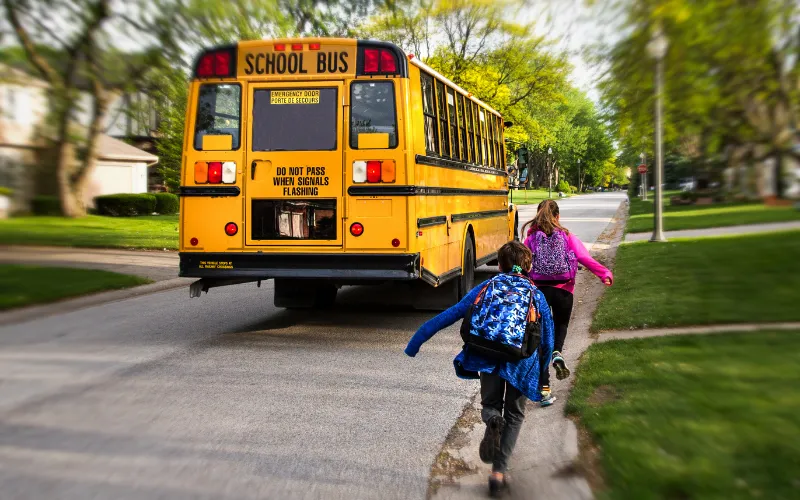
All three states also require drivers to stop completely for a school bus with its red lights flashing and stop arm extended, regardless of which direction the driver is traveling, except on certain divided highways with a physical median separating the roadways.
Penalties for speeding or distracted driving in a school zone
The consequences for breaking these rules are steeper than a typical traffic ticket, and lawmakers have continued tightening them. In New York, speeding tickets in a school zone scale sharply with how far over the limit a driver was going, and recent 2026 changes increased points for several related violations: distracted driving with a handheld device now carries 6 points, failing to yield to a pedestrian now carries 5 points, and passing a stopped school bus now carries 8 points, up from 5. Fines for illegally passing a stopped bus in New York range from $250 to $400 for a first offense, rising to $600–$750 for a second offense within three years, with the possibility of jail time and a license suspension after repeated violations.
New Jersey imposes fines generally between $100 and $250 for passing a stopped school bus, along with 5 points and the possibility of up to 15 days in jail or community service for a first offense. Failing to stop for a pedestrian in a crosswalk near a school adds 2 points on top of any fine.
Pennsylvania fines speeding in an active school zone up to $500, with 3 points added to the driver’s record, and a second violation can trigger a 60-day license suspension. Passing a stopped school bus in Pennsylvania carries a $250 fine (or $300 if the bus uses an automated stop-arm camera system), 5 points, and an automatic 60-day license suspension.
What bus drivers and school districts are legally required to do
School districts and bus operators carry their own legal responsibilities, separate from the drivers around them. Bus drivers must activate flashing lights and the stop arm properly before loading or unloading students, check mirrors and blind spots carefully before moving the bus again, and follow established routes and stop locations that have been reviewed for safety.
School districts are generally responsible for maintaining their bus fleets, training drivers appropriately, and designing safe pickup and drop-off routes. Falling short on any of these duties can expose a district or bus company to liability if a child is hurt as a result.
What to do if your child is injured?
Discovering your child was hurt near a school, crosswalk, or bus stop is frightening, and what happens in the hours and days afterward matters for both their recovery and any future claim. Seek medical attention immediately, even if the injury looks minor at first, since children sometimes downplay pain or don’t fully understand what they’re feeling. Get the names of the driver, any witnesses, and the responding officer, and request a copy of the police report once it’s available.
Take photographs of the scene if you’re able, including the crosswalk, any posted speed limit signs, and the vehicle involved. Avoid speaking with an insurance adjuster about the details of the crash before consulting an attorney, since early statements are sometimes used later to shift blame onto the child or family.
Can a school district or bus company be held liable?
Yes, in certain circumstances. If a bus driver’s negligence, such as opening the doors before checking for oncoming traffic, contributed to the injury, the bus company or school district may share responsibility alongside any other negligent driver involved. Claims against a public school district often involve additional procedural requirements, including strict notice deadlines that are much shorter than a typical personal injury statute of limitations, so acting quickly is especially important in these cases.
Steps to take if a school zone or bus stop accident happens
Beyond the immediate aftermath, a few additional steps protect your family’s legal position in the weeks that follow. Keep a written log of your child’s symptoms, medical appointments, and any missed school days, since this record often becomes important evidence later. Preserve any physical evidence, like damaged clothing or a broken bicycle helmet, rather than discarding it.
Reach out to a personal injury attorney before accepting any settlement offer, particularly one that arrives quickly after the crash. Insurers sometimes move fast specifically because they hope a family will accept a low offer before understanding the full extent of a child’s injuries, a concern we address in more detail in our guide to average car accident settlement values. Finally, keep your child’s pediatrician informed of the full accident circumstances so their records accurately reflect the connection between the crash and any ongoing symptoms.
How Rose Harper Law can help families after a school zone or bus stop injury
Rose Harper Law focuses exclusively on personal injury cases, and we understand how overwhelming it feels when your child is the one who’s hurt. We investigate every angle of a school zone or bus stop crash, from the driver’s conduct to whether a bus company or district shares responsibility, and we handle the insurance negotiations so your family can focus on your child’s recovery. We offer bilingual representation in English and Spanish, free consultations, and we never charge a fee unless we win your case.
For more information on school zone and bus safety rules, resources like PennDOT’s school bus safety page and NHTSA’s school bus safety guidance offer helpful background for families in all three of our states.
Call us today: in New York at 201-377-2337, in Pennsylvania at 610-757-1603, or in New Jersey at 973-200-1744, for a free consultation. Our offices in Westchester County, Allentown, and Parsippany are ready to help your family before, during, and after the new school year begins.
Disclaimer:
This article is intended for informational purposes only and does not constitute legal advice. Reading this content or contacting our firm does not create an attorney-client relationship. Results vary depending on the specific facts of each case. For guidance about your specific situation, please contact Rose Harper Law directly. Our offices are located in Westchester County, Allentown, and Parsippany, and we proudly serve clients throughout New York, New Jersey, and Pennsylvania.

Attorney Rose Harper has dedicated her career to fighting for personal injury victims, recovering over $1,000,000 in compensation on behalf of her clients. Her practice is built on an unwavering commitment to client advocacy, with a focus on high-stakes cases involving catastrophic motor vehicle accidents, premises liability, and wrongful death actions. Rose is known for her rigorous approach to case development, ensuring that each client pursues the full and fair compensation they are entitled to under applicable law.